










AI and automation
What is automated credentialing? A practical guide for healthcare operations leaders
Credentialing is where growth quietly goes to wait. And the wait can be long: under traditional workflows, credentialing a provider with a payer takes 90 to 120 days on average, and can stretch past 180.
A provider is hired, ready, and eager to see patients — and then sits in a queue for weeks while applications are keyed by hand, primary sources are chased one portal at a time, and a committee waits on a file that isn't ready. Every day in that queue is a day of care not delivered and potential revenue not earned. Industry benchmarks put the cost of a single day's onboarding delay at roughly $10,122 to a medical group.
Automated credentialing is the industry's answer to that bottleneck. But "automated" is a loaded word in a regulated process, and the version that actually works looks different from the fully hands-off fantasy some vendors may sell. Here's what automated credentialing really means, where automation earns its keep, and where human expertise still has to stay in the room.
What automated credentialing means
Credentialing is the process of verifying that a provider — an MD, DO, NP, PA, therapist, or other clinician — is who they say they are and holds the qualifications they claim. It means collecting a provider's data, verifying it against primary sources, assembling a file, and getting that file in front of a credentialing committee or payer for a decision.
Automated credentialing applies software to the repetitive, rules-based parts of that work: gathering data, filling forms, collecting verifications, and moving files through a workflow. What it doesn't mean is a fully hands-off process. The National Committee for Quality Assurance (NCQA) requires human review for certain aspects of the credentialing process, so a fully automated credentialing workflow wouldn't meet those requirements.
The regulated determination still belongs to people. The honest definition is intelligent automation plus expert oversight: automation compounds a credentialing specialist's capacity; it doesn't replace their judgment.
That distinction is what separates a credentialing operation that scales from one that can't stand up to scrutiny.
Why manual credentialing can break down
Manual credentialing breaks down because the work doesn't scale linearly, not because credentialing teams lack skill. Add providers, add states, add payers, and the coordination load compounds:
- Data entry multiplies. The same provider details get retyped into the Council for Affordable Quality Healthcare (CAQH) profile, payer forms, and internal systems. Each keystroke is another chance for the error that sends a file back.
- Primary source collection is a scavenger hunt. Licenses, board certifications, and sanctions checks live across dozens of portals, each with its own login, format, and quirks.
- Follow-up eats the calendar. Payer emails and status checks pile up, and a single missed reply can stall an application for weeks.
- Renewals sneak up. Recredentialing and license renewals arrive on a schedule no spreadsheet reminder reliably survives.
The result is predictable: providers wait, administrative costs climb, and revenue that should already be flowing stays locked behind paperwork.
Where automation earns its keep in the credentialing process
Credentialing automation earns its keep on the parts of the work that are repetitive, high-volume, and rules-based. In practice, that includes:
- Document extraction. Providers upload their documents, and AI pulls the relevant data to speed profile completion, with specialists reviewing what's extracted.
- Form filling. Robotic process automation (RPA) enters provider data into CAQH and payer forms, reducing the manual keying that introduces errors.
- Primary source collection. Automation navigates payer and licensing portals (including multi-factor authentication) to collect primary source verification (PSV) data, which credentialing experts then verify. The collection is automated; the verification stays human-reviewed.
- Email and follow-up triage. AI processes inbound payer emails, extracts the key information, and surfaces what needs a response, so specialists spend their time deciding rather than sorting.
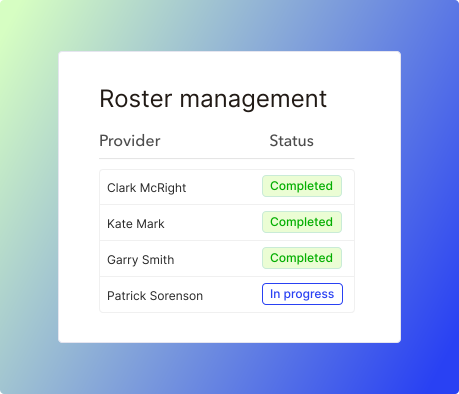
- Roster generation. Automation generates and submits payer rosters against payer-specific requirements.
The pattern is consistent: automation does the fetching, filling, and sorting; people do the verifying, judging, and deciding. That division of labor is what helps keep a credentialing file defensible.
Why experts have to stay in the loop
It's tempting to read "74% of license verifications automated" and assume the goal is 100%. It isn't, and that's by design. At Medallion, 74% of license verifications are automated, with the remainder reviewed manually, and the automated portion is still built around human review at the points that matter.
Credentialing carries real regulatory weight. NCQA and comparable standards expect verifications performed and reviewed with rigor, and the final credentialing decision sits with the committee or payer, not with a piece of software.
Automation that removes the reviewer doesn't just risk a bad file; it risks an audit failure that can cost an organization its delegated credentialing status. Keeping specialists embedded for judgment, compliance, and escalations is what helps an organization move faster and stay defensible.
How fast credentialing could get with automation
When automation and expert oversight work together, the clearest payoff is speed. With Medallion, a credentialing file is ready in about one day, on average. From there, the median is roughly 13 days to complete NCQA credentialing, and about 7 days to credential a provider with a payer. The file stops waiting on manual assembly, so the regulated review can begin on a file that's already complete.
Two more numbers round out the picture:
- Reliability on renewals. 99.9% of recredentialing completed before the deadline over the past year.
- Lower overhead. An estimated 66% reduction in administrative costs.
Speed and reliability figures are medians across files over the trailing 12 months; averages run higher.
Customer results point the same way. Southwest Medical Imaging (SMIL) reports an 80% reduction in credentialing time and 50% less staff time, and PM Pediatric Care reports a 50% reduction in credentialing denials, both after moving off manual workflows. As with any customer figure, treat these as representative of what's possible, not a guaranteed outcome for an organization.
At platform scale, that adds up to roughly 300 healthcare organizations managing nearly 500,000 providers on Medallion, with more than 55 million primary source verifications completed to date.
How to evaluate a credentialing automation partner
Not all "automation" is equal. Five questions to ask a vendor before you commit:
- Where do people stay in the loop? If a partner can't name the review steps, be skeptical. A credentialing process with no human in it is a potential compliance problem waiting to happen.
- What exactly is automated? "Automated credentialing" should decompose into specific steps (data extraction, form filling, PSV collection, follow-up), not a vague end-to-end promise.
- Does it hold up to NCQA scrutiny? Ask how the workflow supports NCQA-ready files and whether verifications are documented for audit.
- What's committed in the contract? Timing commitments should live in a service-level agreement (SLA) rather than a sales deck.
- Will it scale across states and payers? The real test isn't one clean file; it's 500 of them across every state and payer you touch.
Move providers from hired to billable, sooner with the right credentialing partner
Credentialing will not be the reason a patient chooses your organization. But it can be the reason a provider waits weeks to see them. Automation, paired with credentialing experts who stay accountable for the regulated work, is how healthcare organizations can shorten that wait without adding headcount or cutting corners on compliance.
If your credentialing queue has become a growth ceiling, it may be time to see what automation with expert oversight looks like in practice. See how Medallion helps healthcare organizations credential faster.
Frequently asked questions about automated credentialing
Can provider credentialing be fully automated?
No. Automation handles the repetitive, rules-based steps — data extraction, form filling, primary source collection, follow-up triage — while credentialing specialists review the results and a committee or payer makes the final decision. NCQA and similar bodies require human review, validation, and documentation on verifications, so a process with no human in the loop could pose audit risk.
How does automation improve credentialing turnaround times?
It can remove the slow, manual parts: re-keying provider data, chasing primary sources across portals one at a time, and sorting payer follow-up. That frees specialists to spend their time on the judgment and review that actually need a person — which is what compresses the days a file spends waiting rather than moving.
How long does it take to credential a provider?
It varies by provider, state, and payer, since much of the process depends on external sources and payer response times. As a benchmark, healthcare organizations on Medallion see a median of about 7 days to credential a provider with a payer and roughly 13 days for NCQA credentialing (medians over the trailing 12 months; averages run higher).
What are the most common reasons for credentialing denials?
Denials can trace back to file problems: incomplete applications, missing or expired primary source verifications, and data-entry errors that send a file back for rework. Automation can reduce the manual keying behind many of those errors and helps flag gaps before submission, with specialists reviewing what's caught.
Can a provider see patients before credentialing is complete?
Generally no — a provider usually can't be reimbursed by a payer until credentialing and payer enrollment (see: What is payer contract management?) are complete, which is why a provider can be hired and ready but still waiting weeks to bill. Shortening that gap is the main reason organizations turn to automation with expert oversight.
How does automation help with recredentialing?
Recredentialing and license renewals arrive on a fixed schedule that can be easy to miss manually. Automation helps track upcoming deadlines, collects updated verifications, and surfaces what needs attention, with specialists reviewing before anything is finalized — which helps teams stay ahead of renewal dates rather than reacting to lapses.